top of page

Celestial Sunday: The Search for Life in the Oceans of Europa
Europa is a moon of Jupiter. It is the sixth-closest moon to the planet. Current scientific evidence suggests that Europa contains a large liquid water ocean beneath its icy surface. This moon is a primary target for astrobiological research. The Europa Clipper mission, which launched on October 14, 2024, is currently in transit to the Jovian system. It is scheduled to arrive in April 2030. The objective of the mission is to determine if Europa has environments that could sup

Helvarix Systems
May 34 min read
Observing the Eta Aquariids: A Guide to the 2026 Peak
The Eta Aquariid meteor shower is an annual celestial event resulting from Earth’s intersection with the orbital debris of Comet 1P/Halley. In 2026, the peak of this activity occurs between May 5 and May 6. This guide provides technical data regarding the orbital mechanics of the debris stream, the specific viewing conditions for the 2026 cycle, and the methodology required for successful observation. Event Overview The Eta Aquariids are active from April 19 to May 28 each
Helvarix Systems
May 25 min read

Extraterrestrial Mining: The Future of In-Situ Resource Utilization
In-situ resource utilization (ISRU) is the practice of collecting and processing materials found at a mission destination to replace resources that would otherwise be transported from Earth. Current space exploration logistics are limited by the high mass penalty of orbital launches. Transporting every kilogram of life support, fuel, and structural material from Earth's gravity well significantly restricts mission duration and scope. Transitioning to a model of extraterrestri
Helvarix Systems
May 15 min read

JWST's Latest: Peering into the Galactic Dawn
The James Webb Space Telescope (JWST) provides data on the early universe. Recent observations focus on the epoch of galaxy formation. This period is called the galactic dawn. It occurred between 100 million and 1 billion years after the Big Bang. Researchers use the telescope to identify high-redshift objects. Redshift occurs when light from distant objects stretches into longer wavelengths. This process is caused by the expansion of the universe. For distant galaxies, visib
Helvarix Systems
Apr 304 min read
Voyager 1's Resilience: Engineering from 15 Billion Miles
Voyager 1 is the most distant human-made object in existence. As of April 2026, the spacecraft is approximately 15 billion miles (24 billion kilometers) from Earth. It has been operating for over 48 years since its launch on September 5, 1977. Maintaining a functional spacecraft at this distance presents unique engineering challenges involving signal decay, hardware degradation, and extreme communication latency. In late 2023, Voyager 1 encountered a critical failure that thr
Helvarix Systems
Apr 295 min read
Starship & Artemis: The Infrastructure of Return
The Artemis program is the current framework for human lunar exploration. This program utilizes a multi-component infrastructure to facilitate the return of personnel to the lunar surface. The primary elements of this infrastructure include the Space Launch System (SLS), the Orion spacecraft, and the Starship Human Landing System (HLS). Starship Human Landing System Engineering Specifications The Starship HLS is a modified variant of the SpaceX Starship vehicle. It is desig
Helvarix Systems
Apr 284 min read
LEO Logistics: Managing the Orbital Traffic Jam
Low Earth Orbit (LEO) is the region of space located between 160 kilometers and 2,000 kilometers above the surface of the Earth. This region contains the highest density of artificial satellites. As of 2026, the International Telecommunication Union (ITU) has recorded over one million satellite applications for this altitude range. The management of these assets requires precise logistical planning and adherence to orbital physics. 1. Physics of Low Earth Orbit Objects in L
Helvarix Systems
Apr 274 min read

Simulating Martian Dust: The Ultimate Stress Test for Autonomous Rovers
Planetary exploration requires hardware that functions in environments where human intervention is impossible. Mars presents a unique set of mechanical and digital challenges. The atmosphere is thin, the gravity is approximately 38% of Earth's, and the surface is covered in abrasive, electrostatic dust. These factors contribute to high failure rates in autonomous systems. High-fidelity planetary environment simulators are used for planetary environment modeling. They support
Helvarix Systems
Apr 268 min read

Beyond the Visible: Why Spectral Analysis is the New Gold Rush in Astronomy
Spectral analysis is the study of light interaction with matter. This process is necessary for identifying the chemical composition of objects in space. Modern astronomy utilizes this data to characterize exoplanet atmospheres, distant stars, nebulae, galaxies, and interstellar clouds. Astronomical data networks and observatory infrastructure provide the systems required to collect and analyze these spectral signatures. Astronomers do not usually sample an object directly. Th
Helvarix Systems
Apr 258 min read
The Great Silence: Using Distributed Arrays to Listen for SETI Signals
The search for extraterrestrial intelligence (SETI) involves the detection of technosignatures. These are indicators of technology used by civilizations in the cosmos. Scientists observe narrow-band radio signals to identify these signatures. Natural celestial bodies produce wide-band emissions. Artificial transmitters can produce narrow-band, persistent, or structured emissions that differ from most natural sources. The primary challenge in this research is distinguishing ex
Helvarix Systems
Apr 249 min read
Comet C/2026 A1 (MAPS): A Simple Look at a Comet’s Final Journey
Introduction to C/2026 A1 (MAPS) C/2026 A1 (MAPS) drew attention quickly after discovery because it was the kind of comet that promised change. It was headed for a very close pass by the Sun, and that gave observers a clear reason to watch closely from the start. What made it compelling was not just what it was, but how it behaved. Over the following weeks, the comet grew brighter and more active. It changed enough for people to feel like they were watching a real event unfo
Helvarix Systems
Apr 233 min read

Artemis II Post-Mission Report: What 10 Days in Lunar Orbit Taught Us
Mission Overview The Artemis II mission concluded on April 10, 2026. This mission represented the first crewed flight to the lunar vicinity since 1972. The crew consisted of astronauts Reid Wiseman, Victor Glover, Christina Koch, and Jeremy Hansen. The mission duration spanned 10 days. The Orion spacecraft traveled 695,081 miles. The primary objective of Artemis II was to verify the performance of the Space Launch System (SLS) and the Orion spacecraft in a crewed configurati
Helvarix Systems
Apr 227 min read
Venus meets Uranus: A Rare Celestial Conjunction in the Pleiades
A Simple Guide to Seeing Venus and Uranus Together On April 23, 2026, Venus and Uranus will appear close together in the evening sky. They will be near the Pleiades, a compact star cluster that is easy to recognize once you know where to look. This puts several notable objects into one part of the sky. Venus will be the first thing you notice. It will stand out low in the west after sunset and will be much brighter than the surrounding stars. Uranus will be much fainter and
Helvarix Systems
Apr 213 min read
The Lyrid Meteor Shower: Catching the 2,700-Year-Old Dust of Comet Thatcher
The Lyrid meteor shower reaches its annual peak on April 22, 2026. This celestial event occurs as Earth intersects the debris trail of Comet C/1861 G1 (Thatcher). For the 2026 cycle, observational conditions are favorable due to specific lunar positioning and atmospheric timing. This post details the technical specifications of the shower, the history of its parent body, and the observational methods used to capture meteor activity. Observational Parameters for 2026 The Lyr
Helvarix Systems
Apr 206 min read
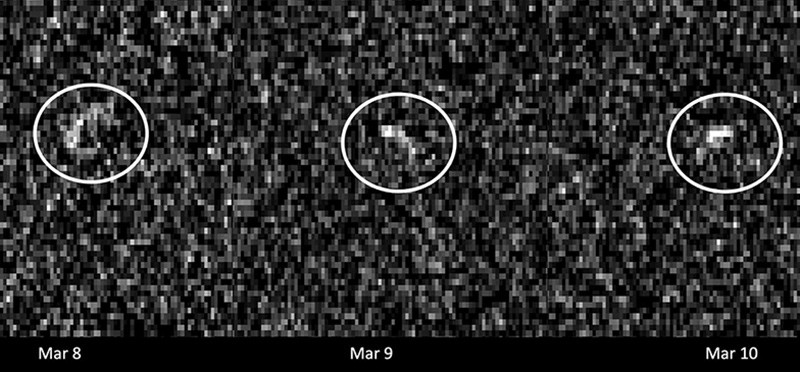
Apophis 2029: Why This Asteroid Flyby is a Once-in-a-Lifetime Research Opportunity
On April 13, 2029, Apophis will pass within about 32,000 kilometers of Earth’s surface. That is closer than geostationary satellites, which are the spacecraft that appear fixed over one point on Earth and handle services like communications and weather coverage. In other words, this asteroid is not just passing by in the general neighborhood. It is making an unusually close visit. The hero image here is a real NASA radar view of Apophis. That matters because radar imagery doe
Helvarix Systems
Apr 197 min read

Swarm Intelligence: Designing Satellite Constellations That Actually Work
The satellite industry is moving away from the use of single, large spacecraft. The current engineering standard utilizes "swarms" or constellations of smaller satellites. This transition improves mission reliability and data collection efficiency. The Helvarix Orbital Platform provides the tools necessary to design, track, and manage these distributed systems. Transitioning to Distributed Systems Historically, orbital missions relied on single-point assets. These large sat
Helvarix Systems
Apr 184 min read
Aerospace Simulation: Why the Best Missions Start in Code
Aerospace missions require high levels of precision and reliability. The cost of physical failure in orbital or planetary environments is high. To mitigate these risks, modern engineering teams utilize simulation software to validate hardware and software systems before launch. This document outlines the technical requirements, methodologies, and tools used in aerospace simulation, with a focus on the upcoming Helvarix Autonomous Systems Simulator. 1. The Role of Simulation
Helvarix Systems
Apr 174 min read
Kessler Syndrome: Avoiding the Ultimate Orbital Traffic Jam
A landmark moment: the 2009 collision between Iridium 33 and Cosmos 2251. Credit: NASA/APOD. Space is famously huge, but the neighborhood right above our heads is starting to feel a little claustrophobic. If you’ve ever been stuck in bumper-to-bumper traffic on a Friday afternoon, you know the feeling. Now, imagine that traffic is moving at 17,500 miles per hour, and a fender bender doesn’t just ruin your day, it creates a cloud of shrapnel that ruins everyone’s century. Welc
Helvarix Systems
Apr 163 min read
bottom of page