
Celestial Sunday: The Search for Life in the Oceans of Europa

Europa is a moon of Jupiter. It is the sixth-closest moon to the planet. Current scientific evidence suggests that Europa contains a large liquid water ocean beneath its icy surface. This moon is a primary target for astrobiological research. The Europa Clipper mission, which launched on October 14, 2024, is currently in transit to the Jovian system. It is scheduled to arrive in April 2030. The objective of the mission is to determine if Europa has environments that could support life.
The Physical Structure of Europa
Europa is approximately 3,100 kilometers in diameter. It is slightly smaller than Earth’s Moon. The moon consists of a silicate rock mantle and a metallic core. A layer of water surrounds this rocky interior. The outer layer of this water is frozen into a shell of ice. Scientists estimate the ice shell is between 15 and 25 kilometers thick.
Beneath the ice shell, there is a liquid ocean. Estimates suggest this ocean is 60 to 150 kilometers deep. If these estimates are accurate, Europa contains more than twice as much liquid water as all of Earth’s oceans combined. This ocean remains liquid due to tidal heating. Jupiter’s gravitational pull creates friction within Europa’s interior. This friction generates heat. The heat prevents the subsurface water from freezing solid.
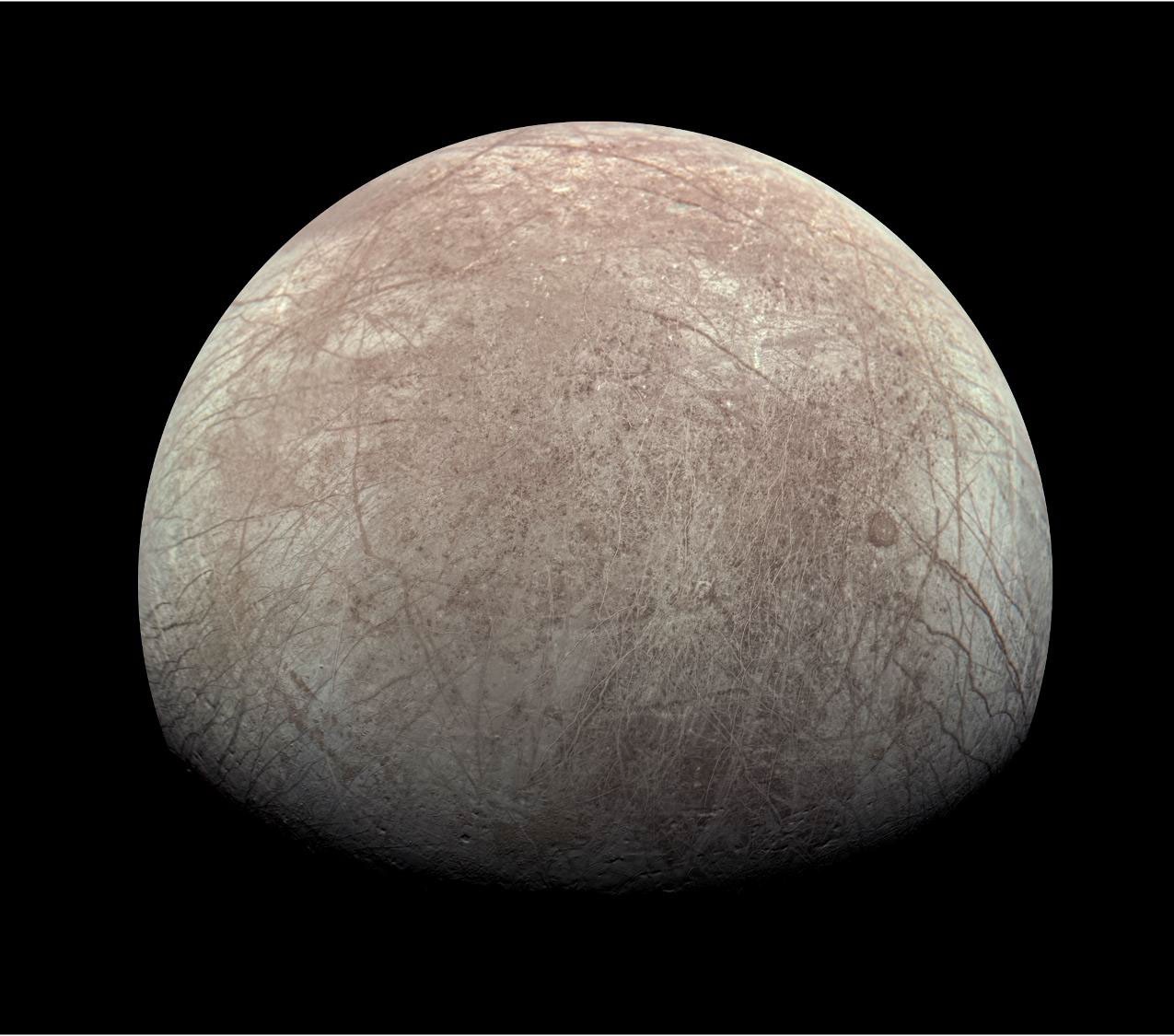
JunoCam composite view from the 2022 flyby showing Europa’s fractured icy surface.
Requirements for Habitability
Habitability requires three main components: liquid water, essential chemical elements, and an energy source.
1. Liquid Water
Liquid water acts as a solvent for biochemical reactions. Europa’s subsurface ocean provides a stable, long-term environment. The pressure and temperature at the bottom of the ocean may be similar to those in Earth's deep oceans.
2. Chemistry
Life requires elements such as carbon, hydrogen, nitrogen, oxygen, phosphorus, and sulfur. These elements were likely present during Europa’s formation. Impacts from comets and asteroids also deliver these materials to the surface. The interaction between the ocean and the rocky seafloor may release minerals into the water. This process is known as hydrothermal activity.
3. Energy
On Earth, most life relies on sunlight. Europa’s ocean is dark. Energy must come from chemical reactions. Radiation from Jupiter strikes Europa’s surface. This radiation breaks apart water and other molecules. This process creates oxidants like oxygen and hydrogen peroxide. If these oxidants move from the surface into the ocean, they can react with reducers from the seafloor. This chemical gradient provides energy for microbial life.
The Europa Clipper Mission Objectives
The Europa Clipper is a NASA spacecraft designed to investigate the moon’s habitability. It is not a life-detection mission. It is a reconnaissance mission to characterize the environment. The spacecraft will perform 49 close flybys of the moon.
The primary science objectives are:
Determine the thickness of the ice shell.
Confirm the existence of the subsurface ocean.
Analyze the chemical composition of the surface.
Identify geological features and recent activity.

Scientific Instrumentation
The spacecraft carries nine primary instruments. These tools allow for remote sensing and in-situ measurements during flybys.
Europa Thermal Emission Imaging System (E-THEMIS): This instrument measures surface temperatures. It identifies areas of "warm" ice where water might be close to the surface.
Europa Imaging System (EIS): This consists of wide-angle and narrow-angle cameras. It maps the surface in high resolution to study geological processes.
Europa Ultraviolet Spectrograph (Europa-UVS): This tool searches for water vapor plumes erupting from the ice. It also analyzes the composition of the atmosphere.
Mapping Imaging Spectrometer for Europa (MISE): This instrument maps the distribution of organics, salts, and acid hydrates.
Radar for Europa Assessment and Sounding: Ocean to Near-surface (REASON): This ice-penetrating radar measures the thickness of the ice shell. It can detect water pockets within the ice.
Interior Characterization of Europa using Magnetometry (ICEMAG): This measures the magnetic field to confirm the ocean's depth and salinity.
Surface Features and Ocean Exchange
Europa’s surface is geologically young. There are very few impact craters. This suggests the surface is constantly being renewed. The most prominent features are "lineae" or dark streaks that crisscross the moon. These are cracks in the ice shell.
"Chaos terrain" consists of broken blocks of ice that have shifted and refrozen. This terrain indicates that the ice shell is dynamic. Scientists believe that material from the ocean may rise to the surface through these features. Conversely, surface oxidants may be transported downward. This exchange is critical for the chemical energy balance of the ocean.

Reprocessed Galileo image showing "chaos terrain" in crisp detail.
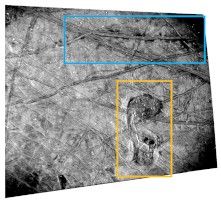
Juno's Stellar Reference Unit (SRU) close-up of the surface.
The Search for Plumes
In 2012, the Hubble Space Telescope detected evidence of water vapor plumes at Europa’s south pole. If these plumes exist, they provide a method to sample the ocean without landing on the surface. The Europa Clipper will fly through these regions. Its mass spectrometers, such as the MASE (Mass Spectrometer for Planetary Exploration), will analyze the molecules in the plumes. This data will reveal the salinity and organic content of the water below.
Future Exploration Phases
Data from the Europa Clipper will inform future missions. If the environment is found to be habitable, the next logical step is a lander mission. A lander would be equipped with instruments to search for biosignatures directly. Current concepts for landers include drills or melt-probes to penetrate the ice shell.
The study of Europa is part of a broader field called ocean world exploration. Other targets include Saturn’s moons Enceladus and Titan. These worlds challenge the definition of a "habitable zone," which was previously limited to planets with surface water.
Navigational Data and Mission Timeline
The mission uses a "gravity assist" trajectory. The spacecraft flew past Mars in early 2025 and will fly past Earth in late 2026 to gain velocity. Upon arrival at Jupiter in 2030, the spacecraft will enter an elliptical orbit around the planet. This orbit minimizes exposure to Jupiter’s intense radiation belts.
You may track the current progress of the spacecraft via the NASA Europa Clipper Mission Tracker. For detailed technical specifications on orbital mechanics, refer to the Jet Propulsion Laboratory's mission logs.
Summary of Key Facts
Mission Status: In transit.
Arrival Date: April 2030.
Ocean Volume: Twice that of Earth.
Target Moon: Europa.
Primary Goal: Habitability assessment.
Europa remains one of the most promising locations for finding life beyond Earth. The data collected by current and future missions will determine if the solar system hosts a second independent origin of life. Continued observation and simulation of these environments are necessary to interpret the findings.
Comments