
Aerospace Simulation: Why the Best Missions Start in Code


Aerospace missions require high levels of precision and reliability. The cost of physical failure in orbital or planetary environments is high. To mitigate these risks, modern engineering teams utilize simulation software to validate hardware and software systems before launch. This document outlines the technical requirements, methodologies, and tools used in aerospace simulation, with a focus on the upcoming Helvarix Autonomous Systems Simulator.
1. The Role of Simulation in Mission Architecture
Simulation is the primary method for verifying that a space system will meet its mission objectives. In the context of aerospace engineering, simulation involves creating a mathematical representation of a physical system and its environment. This allows engineers to observe the interaction between the system and external variables such as gravity, radiation, and thermal cycles.
Simulation occurs at several stages of the mission lifecycle:
Conceptual Design: Validating mission feasibility and initial sizing.
Detailed Engineering: Testing component interactions and control algorithms.
Operational Training: Preparing ground crews for mission management.
In-Mission Support: Troubleshooting anomalies using real-time data from the spacecraft.
2. Digital Twins in Space Systems
A digital twin is a virtual model that serves as the exact functional counterpart of a physical object. In aerospace, this refers to a high-fidelity digital replica of a satellite, rover, or launch vehicle. These models are updated with real-time data to reflect the current state of the physical asset.
Technical Benefits of Digital Twins
Digital twins allow for predictive maintenance and performance optimization. By running the digital twin in a simulated environment that mirrors the spacecraft's current orbital parameters, engineers can predict component wear and potential system failures before they occur.
Key parameters tracked in a digital twin include:
Structural Integrity: Stress and fatigue levels on the chassis and joints.
Thermal Regulation: Heat distribution across internal electronics and external shielding.
Power Consumption: Battery discharge rates and solar array efficiency.
Propulsion Status: Fuel levels and thruster performance metrics.
The use of digital twins reduces the reliance on physical prototypes. This acceleration in the development cycle is documented in current research regarding aerospace mission success.
3. Edge Case Testing and Risk Mitigation
Edge case testing is the process of evaluating a system under extreme or improbable conditions. In aerospace, these conditions often lead to mission failure. Simulation allows for the testing of these scenarios without risking physical hardware.
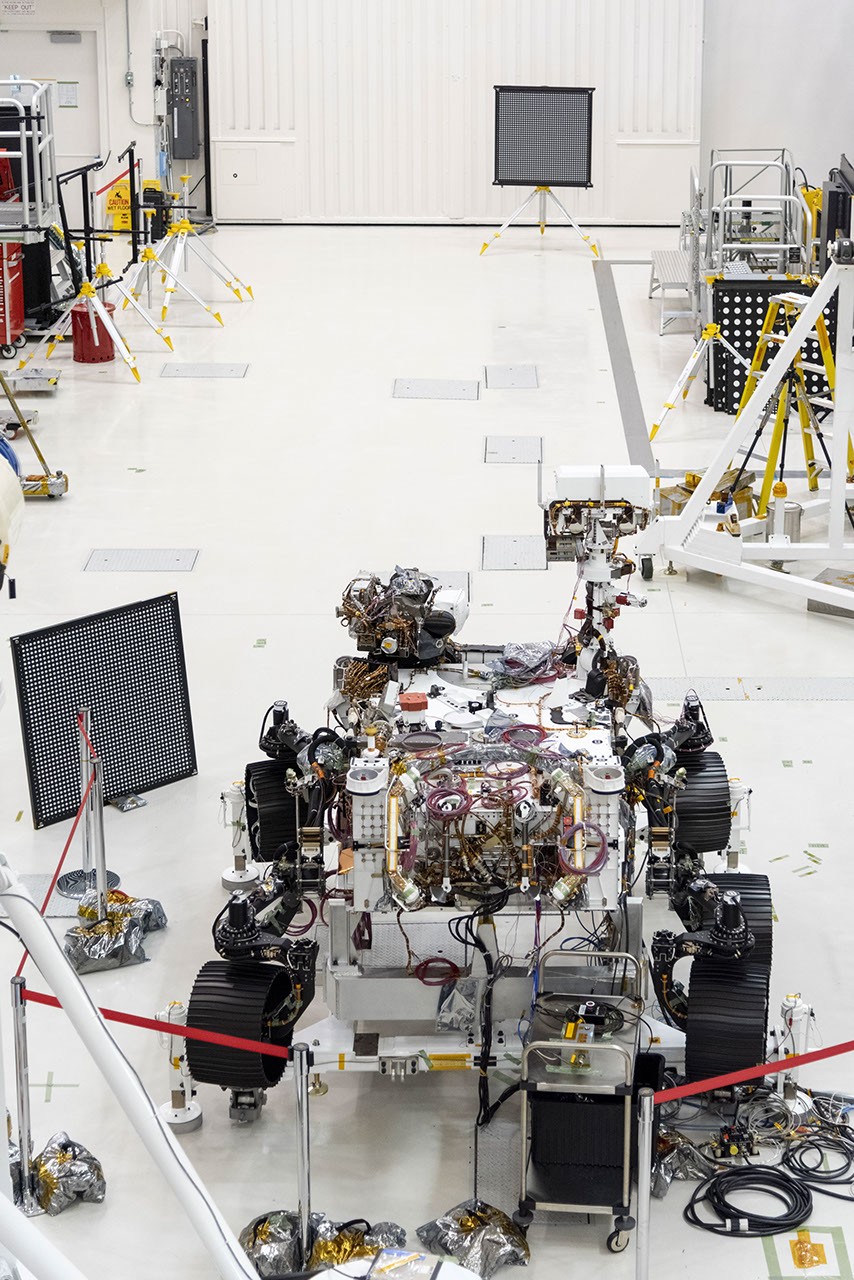
Failure Mode Identification
Engineers use simulation to identify failure modes in autonomous systems. For planetary rovers, this includes:
Mobility Failures: Testing "inching" locomotion in loose soil or high-slip environments.
Obstacle Detection Errors: Evaluating the performance of light sensors and LIDAR in varying light conditions.
Communication Latency: Simulating signal delays to test the autonomy of the navigation software.
Edge case testing ensures that the onboard software can make decisions when ground control is unavailable. This is critical for missions beyond Low Earth Orbit (LEO), where signal latency makes direct remote control impossible.
4. Helvarix Autonomous Systems Simulator
Helvarix Systems is developing the Autonomous Systems Simulator to provide a modular environment for testing robotics. The platform focuses on high-fidelity planetary simulation and robotics performance analytics.
Modular Robotics Design
The simulator allows engineers to build and test modular robotics. The software includes a library of standardized components, such as:
Multi-axial robotic arms.
High-torque planetary wheel systems.
Sensor arrays for atmospheric and geological analysis.
Users can integrate custom CAD models into the simulation environment to verify physical interactions and load-bearing capacities.
Simulated Planetary Environments
The Helvarix platform provides realistic environmental models of the Moon, Mars, and various asteroids. These environments include accurate physics for:
Gravity: Adjustable gravitational constants to simulate different planetary bodies.
Atmospheric Pressure: Effects on flight dynamics and cooling systems.
Surface Composition: Material properties such as regolith density and friction coefficients.
5. Performance Analytics and Mission Archiving
Data collection is a requirement for improving future mission designs. The Helvarix Autonomous Systems Simulator includes integrated analytics tools to track every aspect of a simulated mission.
Real-Time Telemetry Data
The simulator generates telemetry data identical to what a ground station would receive during an actual mission. This data includes:
Motor torque and RPM.
Sensor health status.
Onboard computer CPU and RAM utilization.
Navigation accuracy relative to the planned path.
Mission Archiving
Every simulation run is archived for future review. This allows engineering teams to replay missions, analyze the causes of failures, and perform comparative studies between different hardware configurations. The archiving system supports research data export for use in external statistical analysis tools.
6. Physics-Based Modeling for High-Fidelity Results
Reliable simulation requires physics-based modeling. This approach uses first-principle physics equations to calculate how a system behaves.
Kinetic and Dynamic Analysis
Kinetic analysis models the forces acting on a system, while dynamic analysis models the resulting motion. For a satellite tracked on the Helvarix Orbital Platform, simulation includes:
Orbital Mechanics: Calculating trajectory based on gravitational perturbations and solar radiation pressure.
Attitude Control: Simulating the use of reaction wheels and thrusters to maintain orientation.
Spectral and Optical Simulation
For observation missions, the simulator models the optical characteristics of sensors and telescopes. This includes atmospheric distortion and signal-to-noise ratios. By simulating these variables, researchers can optimize their observation campaigns through the Helvarix Global Array.
7. The Economic Logic of Code-First Missions
The development of aerospace simulation software is an economic necessity. The cost of a failed mission includes the loss of the launch vehicle, the payload, and the years of research invested in the project.
Simulation reduces these costs by:
Reducing Prototype Iterations: Digital testing identifies design flaws earlier, reducing the number of physical prototypes required.
Optimizing Resource Allocation: Precise simulation allows for the minimization of fuel and power requirements, which can reduce the weight and cost of the payload.
Extending Mission Life: Accurate digital twins allow operators to manage aging spacecraft more effectively, maximizing the return on investment.
8. Conclusion
Simulation is the backbone of modern aerospace mission success. By utilizing digital twins, edge case testing, and high-fidelity environmental modeling, organizations can ensure that their systems perform as expected in the harsh environments of space. The Helvarix Autonomous Systems Simulator provides the tools necessary for designing and testing the next generation of autonomous exploration systems.
For more information on simulation tools and mission planning, visit the Helvarix Systems website.
Comments